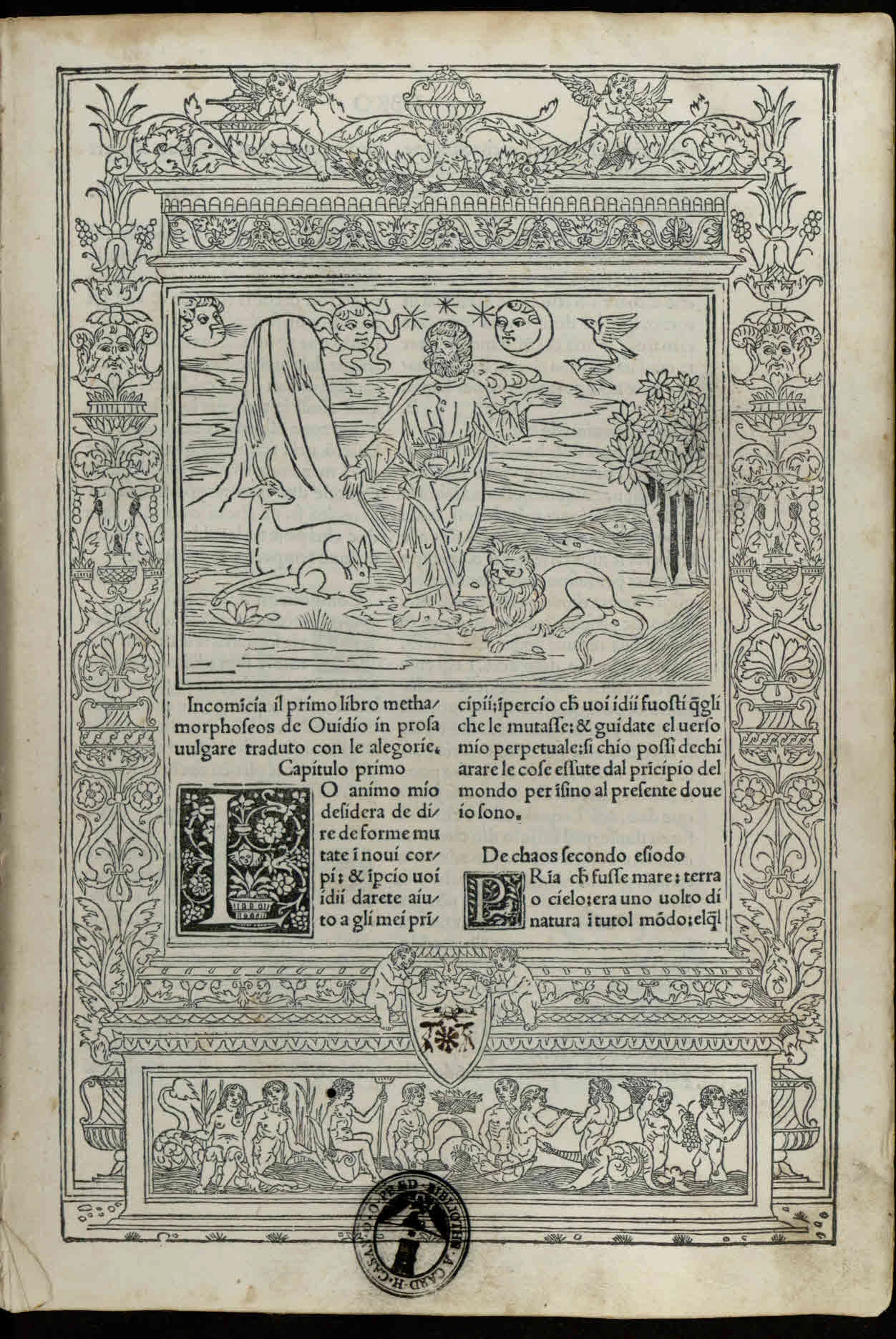

Page from the edition of Ovid's Metamorphoses published by Lucantonio Giunti in Venice, 1497
The Metamorphoses (Latin: Metamorphōsēs, from Ancient Greek: μεταμορφώσεις: lit. "Transformations") is a Latin narrative poem from 8 CE by the Roman poet Ovid. It is considered his magnum opus. The poem chronicles the history of the world from its creation to the deification of Julius Caesar in a mythico-historical framework comprising over 250 myths, 15 books, and 11,995 lines.
Although it meets some of the criteria for an epic, the poem defies simple genre classification because of its varying themes and tones. Ovid took inspiration from the genre of metamorphosis poetry. Although some of the Metamorphoses derives from earlier treatment of the same myths, Ovid diverged significantly from all of his models.
The Metamorphoses is one of the most influential works in Western culture. It has inspired such authors as Dante Alighieri, Giovanni Boccaccio, Geoffrey Chaucer, and William Shakespeare. Numerous episodes from the poem have been depicted in works of sculpture, painting, and music, especially during the Renaissance. There was a resurgence of attention to Ovid's work near the end of the 20th century. The Metamorphoses continues to inspire and be retold through various media.
Contents
The Metamorphoses is comprehensive in its chronology, recounting the creation of the world to the death of Julius Caesar, which had occurred only a year before Ovid's birth; it has been compared to works of universal history, which became important in the 1st century BCE.
Ovid works his way through his subject matter, often in an apparently arbitrary fashion, by jumping from one transformation tale to another, sometimes retelling what had come to be seen as central events in the world of Greek mythology and sometimes straying in odd directions. It begins with the ritual "invocation of the muse", and makes use of traditional epithets and circumlocutions. But instead of following and extolling the deeds of a human hero, it leaps from story to story with little connection.
The recurring theme, as with nearly all of Ovid's work, is love—be it personal love or love personified in the figure of Amor (Cupid). Indeed, the other Roman gods are repeatedly perplexed, humiliated, and made ridiculous by Amor, an otherwise relatively minor god of the pantheon, who is the closest thing this putative mock-epic has to a hero. Apollo comes in for particular ridicule as Ovid shows how irrational love can confound the god out of reason. The work as a whole inverts the accepted order, elevating humans and human passions while making the gods and their desires and conquests objects of low humor.
The Metamorphoses ends with an epilogue (Book XV.871–879), one of only two surviving Latin epics to do so (the other being Statius' Thebaid). The ending acts as a declaration that everything except his poetry—even Rome—must give way to change:
| “ | And now, my work is done, which neither Jove Nor flame nor sword nor gnawing time can fade. |
” |
Books
- Book I – The Creation, the Ages of Mankind, the flood, Deucalion and Pyrrha, Apollo and Daphne, Io, Phaëton.
- Book II – Phaëton (cont.), Callisto, the Raven and the Crow, Ocyrhoe, Mercury and Battus, the envy of Aglauros, Jupiter and Europa.
- Book III – Cadmus, Diana and Actaeon, Semele and the birth of Bacchus, Tiresias, Narcissus and Echo, Pentheus and Bacchus.
- Book IV – The daughters of Minyas, Pyramus and Thisbe, Mars and Venus, the Sun in love (Leucothoe and Clytie), Salmacis and Hermaphroditus, the daughters of Minyas transformed, Athamas and Ino, the transformation of Cadmus, Perseus and Andromeda.
- Book V – Perseus' fight in the palace of Cepheus, Minerva meets the Muses on Helicon, the rape of Proserpina, Arethusa, Triptolemus.
- Book VI – Arachne; Niobe; the Lycian peasants; Marsyas; Pelops; Tereus, Procne, and Philomela; Boreas and Orithyia.
- Book VII – Medea and Jason, Medea and Aeson, Medea and Pelias, Theseus, Minos, Aeacus, the plague at Aegina, the Myrmidons, Cephalus and Procris.
- Book VIII – Scylla and Minos, the Minotaur, Daedalus and Icarus, Perdix, Meleager and the Calydonian Boar, Althaea and Meleager, Achelous and the Nymphs, Philemon and Baucis, Erysichthon and his daughter.
- Book IX – Achelous and Hercules; Hercules, Nessus, and Deianira; the death and apotheosis of Hercules; the birth of Hercules; Dryope; Iolaus and the sons of Callirhoe; Byblis; Iphis and Ianthe.
- Book X – Orpheus and Eurydice, Cyparissus, Ganymede, Hyacinth, Pygmalion, Myrrha, Venus and Adonis, Atalanta.
- Book XI – The death of Orpheus, Midas, the foundation and destruction of Troy, Peleus and Thetis, Daedalion, the cattle of Peleus, Ceyx and Alcyone, Aesacus.
- Book XII – The expedition against Troy, Achilles and Cycnus, Caenis, the battle of the Lapiths and Centaurs, Nestor and Hercules, the death of Achilles.
- Book XIII – Ajax, Ulysses, and the arms of Achilles; the fall of Troy; Hecuba, Polyxena, and Polydorus; Memnon; the pilgrimage of Aeneas; Acis and Galatea; Scylla and Glaucus.
- Book XIV – Scylla and Glaucus (cont.), the pilgrimage of Aeneas (cont.), the island of Circe, Picus and Canens, the triumph and apotheosis of Aeneas, Pomona and Vertumnus, Messapian shepherd, legends of early Rome, the apotheosis of Romulus.
- Book XV – Numa and the foundation of Crotone, the doctrines of Pythagoras, the death of Numa, Hippolytus, Cipus, Asclepius, the apotheosis of Julius Caesar, epilogue.